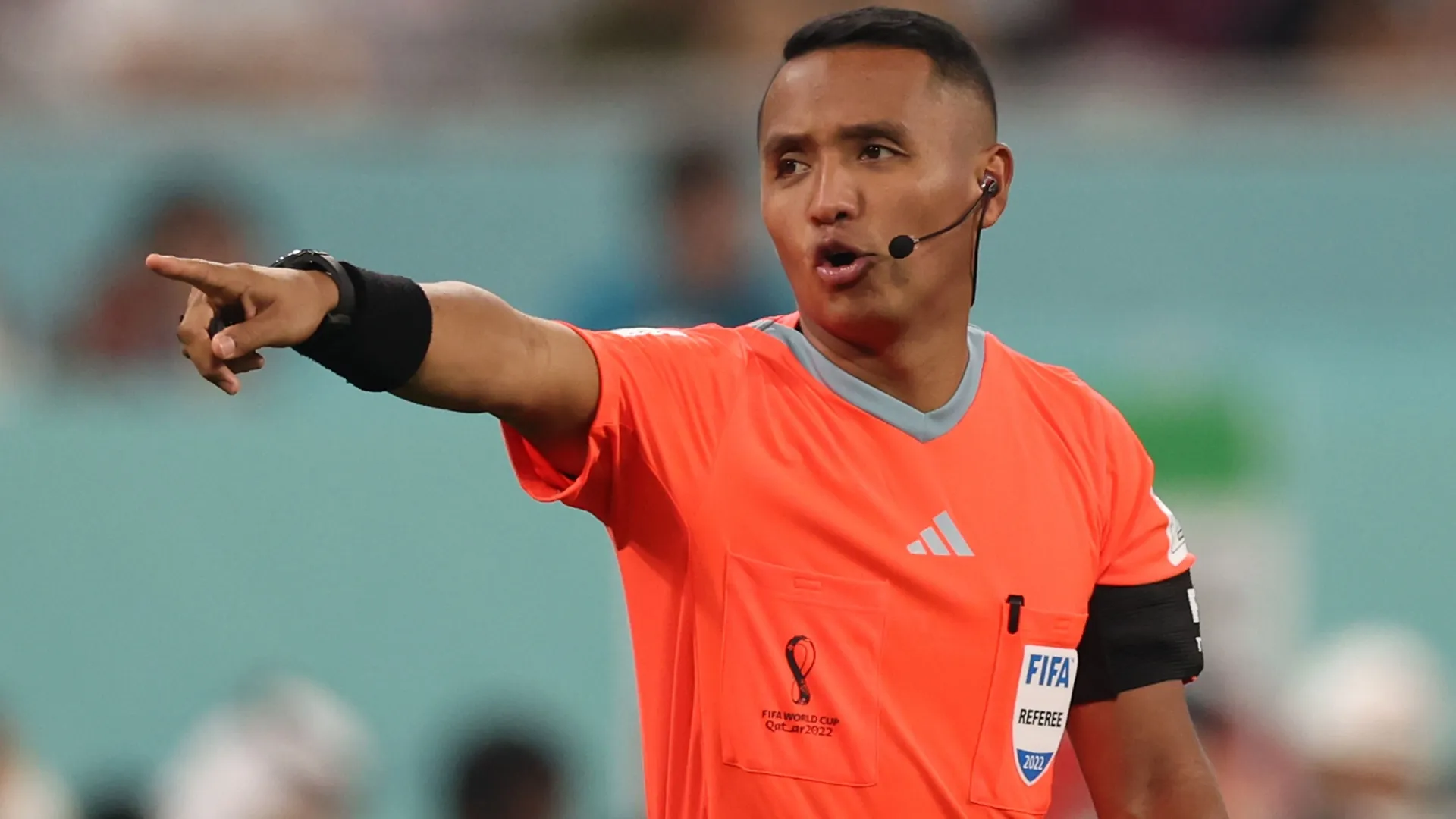


Eight minutes into the France vs Spain World Cup semifinal at AT&T Stadium in Dallas, with 80,000 people watching in a fever pitch and millions more glued to screens across the globe, Iván Barton reached for his hip.
The match was already a pressure cooker. Kylian Mbappé had just been clipped, the Spanish defense was screaming for a simulation call, and the heat of a Texas July was radiating off the pitch despite the roof being closed. Barton, cool as the center of a hurricane, moved to mark the distance for the wall. He reached for his vanishing spray.
Nothing.
He checked the other pocket. Still nothing. For a fleeting second, the most powerful man on the pitch looked like a dad who had lost his car keys at a grocery store. He stood there, hands on his hips, a wry smile creeping across his face. On the sideline, fourth official Glenn Nyberg didn’t wait for a signal; he came sprinting onto the pitch, holding a fresh white can like a relay baton.
The internet, as it is prone to do, exploded instantly. “You had one job,” the memes shouted within seconds, side-by-side with clips of the frantic sideline dash. But if you think a missing can of aerosol spray was enough to rattle Iván Barton, you don’t know the man. Because while the world saw a referee who forgot his gear, the people of El Salvador saw a scientist who had already calculated the variables of the match long before the whistle blew.
Iván Barton is a man who has many jobs, and “referee” is only the most public one.
The Chemistry Professo
Born on January 27, 1991, in the city of Santa Ana, El Salvador, Iván Arcides Barton Cisneros was never just a “soccer kid.” While he certainly shared the national obsession with the beautiful game, growing up in a country that worships legends like El Mágico González, Barton’s mind was always drawn to the precision of the laboratory.
He didn’t just play soccer; he analyzed it. He didn’t just study; he excelled. Barton holds a degree in Chemical Sciences from the University of El Salvador, one of the most prestigious academic institutions in Central America. But he didn’t stop at the degree. For years, he served as a professor of Organic Chemistry at the same university.

To his students, he was “El Profe Barton.” On Tuesday morning, he might be explaining the molecular structure of hydrocarbons or grading lab reports on titration. By Friday night, he was swapping his lab coat for a referee’s kit, flying across the continent to manage 22 of the most volatile personalities in sports.
In a country of 6.3 million people, where the path to international stardom is often narrow and paved with obstacles, Barton became a living symbol of a new Salvadoran dream: the idea that you don’t have to choose between the laboratory and the stadium. You can master the laws of science and the Laws of the Game simultaneously.
The FIFA Rise
Barton’s ascent through the refereeing ranks was as structured and logical as a chemical equation. He received his FIFA badge in 2018 at the age of 27, an incredibly young age for an international official. But CONCACAF knew they had a rare talent on their hands.
He wasn’t just a rule-follower; he was a game manager. By 2019, he was already officiating at the Gold Cup and the FIFA U-17 World Cup in Brazil. His style was defined by a calm authority that seemed to de-escalate even the most heated rivalries.
His first major global statement came in 2022. He was selected for the World Cup in Qatar, where he was handed the assignment of Germany vs Japan. It was a match that would go down in history as one of the great upsets, but Barton’s officiating was flawless. He followed that up with Brazil vs Switzerland and England vs Senegal. He wasn’t just “a referee from El Salvador” anymore; he was one of the top five officials in the world.
The Red Card That Made Headlines
Fast forward to the 2026 World Cup group stage, just weeks before his Dallas semifinal. Barton found himself at the center of a global debate during Turkey vs Paraguay.
In the 64th minute, Paraguay’s Miguel Almirón was involved in a heated exchange with an opponent. As Barton approached, Almirón covered his mouth with his hand while speaking, a common tactic players use to prevent lip-reading by cameras or officials. However, under FIFA’s new “Transparency and Integrity” regulations introduced for the 2026 tournament, covering the mouth while addressing an opponent or official was classified as unsporting behavior, a mandatory yellow card offense.

Since Almirón was already on a yellow, Barton reached into his pocket and produced the red. The clip went viral globally, generating millions of views and sparking a week-long debate on sports talk shows. Was it harsh? Perhaps. But Barton simply enforced the rule as written. He didn’t let the player’s stature or the importance of the match cloud his judgment. As any professor will tell you: the formula doesn’t change just because the student is popular.
Standing Up to Hate
Perhaps the most defining moment of Barton’s career, the moment that proved his character, didn’t happen at a World Cup, but in a 2023 CONCACAF Nations League semifinal between the USA and Mexico.
The match was a disaster of player behavior, with four red cards issued. But the real ugliness came from the stands. When homophobic chants began to echo through the stadium, Barton did something that many officials in the past had hesitated to do. He didn’t ignore it. He didn’t wait for a higher authority to tell him what to do.
He stopped the match.
Barton walked to the sideline, consulted with his crew, and followed the anti-discrimination protocol to the letter. The match was temporarily halted, sending a clear message to the world: football belongs to everyone, and hate has no place on his pitch. It was a moment of immense courage that solidified his reputation as a leader who cared more about the integrity of the game than the comfort of the status quo. This commitment to inclusion is something we value deeply at Sports Media Network, where we believe in empowering inclusive sports mentorship.
The Semifinal: Spain vs France
All of these moments led to July 14, 2026. The World Cup Semifinal.
Barton made history before the opening whistle, becoming the first Central American referee to ever officiate a World Cup semifinal. He walked onto the field at AT&T Stadium, a venue he had become familiar with during his 2026 World Cup journey, accompanied by his trusted Salvadoran assistant David Morán and Nicaraguan Antonio Pupiro.

The match was a tactical masterclass between two European giants. Spain’s Tiki-taka vs France’s explosive transition. Lamine Yamal vs Kylian Mbappé. Barton was invisible for long stretches of the game, which is the highest compliment a referee can receive.
In the 32nd minute, he awarded a penalty to Spain after Lucas Digne fouled Yamal inside the box. It was a brave call in such a high-stakes moment, but VAR confirmed Barton’s initial instinct was perfect. Later, he showed his humility and reliance on his team by overturning a France free-kick after David Morán advised him through the headset that there was no foul.
Spain would eventually win 2-0, securing their place in the final. As the players shook hands and the fans poured out into the Dallas night, the talk wasn’t about the officiating. The talk was about the football. And for Iván Barton, that was the ultimate victory.
What He Represents
Iván Barton is more than just a man with a whistle. He is a testament to the power of the “and.” You can be a scientist and an athlete. You can be from a small town in Santa Ana and stand on the world’s biggest stage.
He has handled the pressure of 80,000 screaming fans with the same calm he uses to balance a chemical equation. He has stood up against discrimination when it would have been easier to look away. And yes, he even handled the viral embarrassment of a missing vanishing spray can with a smile and a shrug.
As you prepare for the World Cup Final and look for your own match day playbook, remember the man in the middle. The chemistry professor who proved that with enough discipline, integrity, and perhaps a little help from your fourth official, any goal is achievable.
El Salvador has given the world many things, but in Iván Barton, it has given the beautiful game a standard-bearer for the next generation of officials. The spray might have been missing, but Barton’s vision for the game has never been clearer.