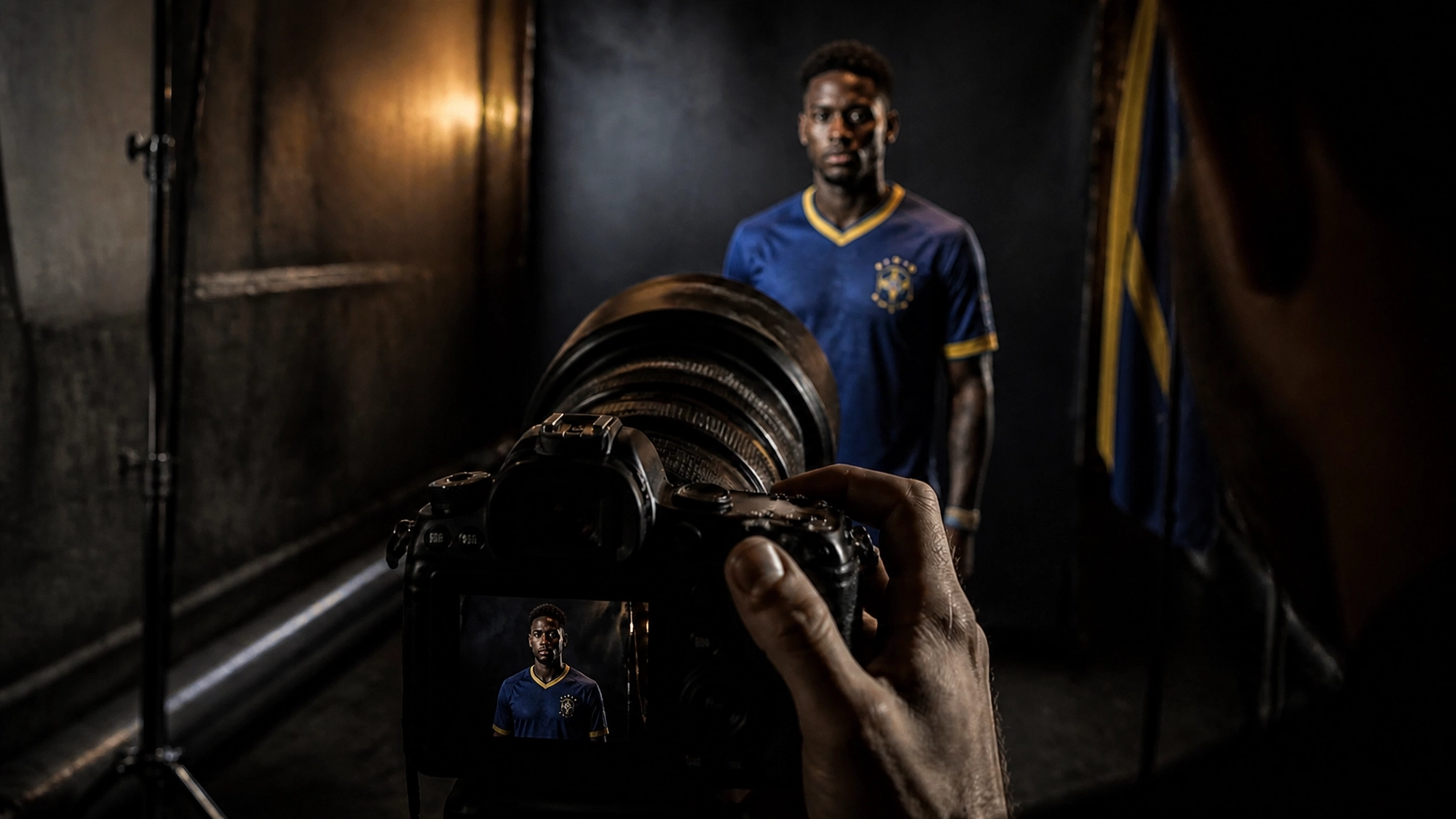


Ever wonder why every single player at the World Cup looks like a superhero before they even step onto the pitch? It’s not just the kit or the fitness. There’s a hidden, high-speed world behind those iconic portraits you see on TV graphics, Panini stickers, and Instagram feeds.
We’re talking about the "Media Day": a logistical beast where 1,248 players and 48 managers from across the globe have to be captured in a way that looks legendary. And here’s the kicker: at the 2026 World Cup, pro photographers are doing it with less time than it takes to brew an espresso.
At Sports Media Network, we live for the culture behind the game. Today, we’re pulling back the curtain on the secret techniques, the "assembly line" pressure, and the artistic hacks that separate the pros from the amateurs.
1. The 15-Second Assembly Line
Imagine having 15 seconds to capture the essence of a global icon. That’s the reality for Getty Images and FIFA’s official photography squads. With 48 teams to process, the workflow is a masterpiece of choreography.
There are two photographers per team, and they work like a NASCAR pit crew.
- 0–3 seconds: The player hits the tape marks on the floor.
- 3–12 seconds: The photographer fires a burst of 5-10 frames. Standard pose (shoulders square), then a slight variation (arms folded or holding the ball).
- 12–15 seconds: A quick check of the tethered screen, and "Next!"
There’s no "Can we try that again?" This is a production line where technical decisions are locked in days in advance so the only thing left to capture is the player’s face.
2. The Lighting "Secret" (It’s Simpler Than You Think)
Aspiring photographers often think they need a forest of equipment to get that "pro" look. The truth? Consistency is the real king.
The World Cup setup is usually remarkably simple: one massive studio strobe with a large softbox as the "key" light, and two rim lights (kickers) behind the player to create that sharp definition around the shoulders and hair. This separation is what makes the player "pop" against the background.
Pros use tape on the floor to mark exactly where the feet go. Why? Because if the player moves six inches, the lighting shifts. By fixing the position, every player: from a 5'5" winger to a 6'6" goalkeeper: stays perfectly lit without the photographer touching a single dial.

3. In-Camera Artistry: Forget Photoshop
You’ve seen those vivid, kaleidoscopic portraits: like the famous ones of Messi where the lights seem to fracture and glow around him. Most fans assume that’s a heavy Photoshop edit.
Wrong. Pro sports photographers are increasingly using physical lens filters (like Tiffen, CineBloom, or Prism filters) to create these effects in-camera. By holding a piece of fractured glass or a kaleidoscope filter in front of the lens, they can create repeating geometric patterns and light flares while keeping the player’s eyes tack-sharp.
They usually run two setups:
- The "School Photo": A plain, clean shot for official database use.
- The "Creative": A distinctive, artistic setup with custom backdrops or filters that define the "vibe" of that specific World Cup.
4. The Rise of the Image-Conscious Athlete
Gone are the days when a player would just stand there and shrug. In 2026, players are brands. They come to these sessions with pre-rehearsed poses. They know which side is their "good side," and they often ask to review the images on the tethered laptop immediately.
Because of social media and multimillion-dollar boot deals, the players are just as invested in the "look" as the photographer. It’s a collaboration, even if it only lasts 15 seconds.
5. The Marcelo Bielsa Moment: Personality Over Pose
While most players and coaches want to look like models, some of the best portraits come from those who refuse to play the game. Take Uruguay’s legendary manager, Marcelo Bielsa.
In a sea of smiling, "power-pose" portraits, Bielsa’s 2026 portrait stands out because he refused to look at the lens. He looked down at the floor, appearing exactly as he is: a man obsessed with the work, indifferent to the cameras. It was raw, authentic, and revealed more personality than any staged smile ever could. The secret here? Sometimes, the "wrong" shot is the only right one.
6. The Vikings are Coming: David Yarrow’s Norway Epic
When you want to move beyond the studio, you get someone like David Yarrow. For Norway’s 2026 World Cup send-off, Yarrow ditched the traditional "players on a plane" shot and took the entire squad to a private beach near an Oslo fjord.
Dressed in full Viking gear: shields, axes, and longships included: the shot featured stars like Erling Haaland and Martin Ødegaard. It wasn't AI; it was a massive, multi-stage production. Haaland (who Yarrow says "doesn't need much help looking like a Viking") was the anchor. Ødegaard, busy with the Champions League, was shot separately and composited in later.
Behind-the-scenes footage was released specifically to prove the image's authenticity in the age of AI. It proves that even in the digital era, there is no substitute for a real lens and a massive fjord.

7. The Insider: Ricardo Ulloa’s "Striker Instinct"
At Sports Media Network, we’re lucky to have Ricardo Ulloa as our featured photographer. Ricardo isn't just a guy with a camera; he’s a former Salvadoran professional footballer.
That background is his "secret sauce." When Ricardo is behind the lens, he isn't just looking for a clean exposure; he’s using his striker’s intuition to anticipate the rhythm and grit of the game. He knows when a player is about to break, when the emotion is about to peak, and how to capture the "athlete's soul" because he’s lived it himself.
"You have to feel the game to shoot the game," Ricardo often says. That's the difference between a technician and a storyteller.
8. Practical Takeaways for Aspiring Photographers
Want to shoot like the World Cup pros? Here’s your cheat sheet:
- Build Accreditation: You can't get into the stadium without a portfolio. Start local. Shoot grassroots movements and local clubs to build a body of work that proves you can handle the speed.
- Shoot RAW: The lighting might be fixed, but the post-production latitude of RAW files is essential for matching the vibrant "World Cup" color palette.
- Embrace AI Culling: Pros don't look through 5,000 frames one by one. They use AI-assisted tools to instantly flag the sharpest images and the ones where eyes are open.
- Simplicity Wins: Don't overcomplicate your lighting. Master one light first. If it was good enough for 1,248 World Cup players, it's good enough for your subject.
- Focus on Personality: Like the Bielsa shot, don't just aim for a "clean" image. Aim for an authentic one.

The 2026 World Cup is more than just a tournament; it’s a masterclass in visual storytelling. Whether it's a 15-second studio blitz or an epic fjord production, the "secrets" are always the same: preparation, intuition, and a deep love for the game.
Stay tuned to Sports Media Network for more behind-the-scenes coverage as the tournament unfolds!